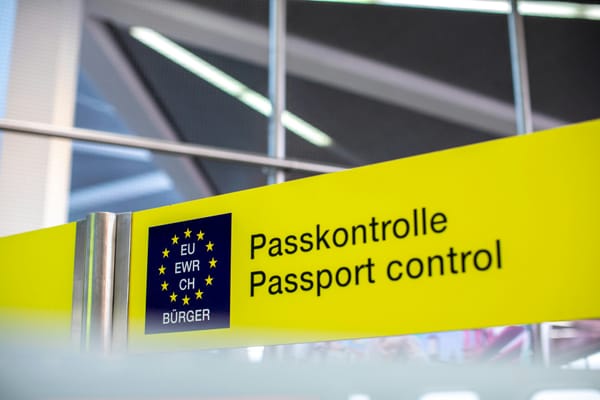
🛂 The $250 US entry fee could switch on any week. Is your team exposed?
Signed a year ago. No launch date. Non-refundable. Here's who actually pays.

🛂 The $250 US entry fee could switch on any week. Is your team exposed?
Signed a year ago. No launch date. Non-refundable. Here's who actually pays.

Egor Travel Code
July 14, 2026
Boarding Call 🚀
A $250 fee. No launch date. No refund portal. Already live at some consulates. Your traveler could hit it next week — and it won't show up in any budget you've set. This week: who actually pays, who thinks they're exempt but isn't, and what to do before finance finds out from an expense report.
📌 This week
One year ago this month, the US quietly signed a new $250 "Visa Integrity Fee" into law. Most travel programs filed it under "someday." Someday is now. The fee took effect on paper on 1 October 2025 — but collection has been rolling out unevenly, consulate by consulate, with no global switch-on date. Some US embassies are already charging it. Others are still waiting on payment and tracking systems to go live. Which means it can appear at your traveler's visa appointment, in their city, on any given week — with no warning and no line item in your budget.
Here's the part most people get wrong: they assume they're not exposed because their people travel visa-free. Half of that is true. The other half is where the money is.

💳 Who Actually Pays — and Who Doesn't
The $250 fee lands on anyone who needs a nonimmigrant visa stamp to enter the US: B-1/B-2 (business and meetings), H-1B, L-1, O-1, E-3, TN, plus F-1 and J-1. It's charged per person, per visa — dependents on H-4 or L-2 pay it too. And it's collected at visa issuance, so there's no "we'll sort it later." No stamp, no entry.
Visa Waiver Program travelers are exempt. If your traveler holds a passport from one of the ~42 ESTA countries — the UK, Germany, Japan, Australia and the rest — they don't get a visa stamp, so they don't owe the $250.
So who's exposed? Exactly the employees hardest to replace: engineers, sales leads, contractors and new hires traveling from non-VWP countries — India, China, Brazil, Nigeria, and dozens more. If your talent or your growth markets sit outside the visa-waiver list, this fee is a direct, recurring tax on moving those people to the US.
And the fee is technically refundable — but DHS still hasn't launched a portal or published instructions for claiming it, and the Congressional Budget Office expects almost no one will. Treat it as a sunk cost, not a deposit.
⚠️ Why It Matters for Corporate Travel
- It's a cost that hits at the worst possible moment — the consulate counter. Because it's charged at issuance with uneven rollout, you can't predict which trip triggers it. A four-person team traveling on visas is $1,000 in new fees before anyone books a flight, and it recurs every renewal cycle. The $250 also adjusts upward each year by CPI, so this is a floor, not a ceiling.
- Your ESTA travelers aren't off the hook — they just pay in friction, not dollars. The ESTA fee itself rose from $21 to $40 in late 2025 and sits at $40.27 as of January 2026. More importantly, CBP's proposed ESTA overhaul makes five years of social-media history a mandatory data element, adds biometrics and family-detail collection, and moves applications to a mobile-only app. That's longer lead times and more failed/held authorizations on exactly the trips you assumed were frictionless.
- The mood has already shifted, and Europe most of all. In GBTA's April 2026 poll, optimism about business travel fell to 41% globally (from 59% in January), and Europe became the only region where pessimism outweighs optimism — 21% optimistic vs 38% pessimistic. 79% of respondents now rank geopolitical instability as their top travel risk. Entry cost and friction aren't a US footnote; they're feeding a global re-think of where meetings happen.

🛠️ What This Means for Your Travel Program
- Map your non-VWP exposure this week. Pull the nationalities behind your US-bound trips and flag everyone who needs a stamp rather than ESTA. That headcount × $250 (plus dependents) is your new, non-refundable annual liability. Put a real number in front of finance before a traveler does.
- Move the fee into trip cost now. Add $250/visa to your US pre-trip estimates and approvals so it stops being a surprise at issuance. For high-volume US programs, model it into the 2027 budget as a recurring, CPI-indexed line.
- Give ESTA renewals more runway. Brief travelers on the new data requirements and the mobile-only app, and build extra lead time into ESTA renewals — the risk now is a held authorization days before departure, not the $40.
- Decide deliberately where US meetings need to happen. For recurring internal meetings and events, weigh a VWP-friendly hub or a virtual format against the stacked cost and friction. 43% of organizations that frequently send staff to the US already say they're likely to hold more meetings outside it — make that a decision, not a drift.
📊 The Numbers
- $250 — the Visa Integrity Fee, charged per nonimmigrant visa, per person, at issuance; adjusts annually by CPI. Signed into law 4 July 2025 under the One Big Beautiful Bill Act.
- ~42 countries exempt — Visa Waiver Program / ESTA passport holders (UK, Germany, Japan, Australia and others) don't get a visa stamp, so they pay $0 of this fee — but face the ESTA overhaul instead.
- $40.27 — the ESTA fee as of 1 January 2026, up from $21 in September 2025; funding for tourism body Brand USA was cut from $100M to $20M for FY2026.
- 5 years — of social-media history now a mandatory ESTA data element under CBP's proposed overhaul, alongside biometrics and a mobile-only application.
- 43% / 29% — of organizations frequently sending staff to the US say they're likely to hold more meetings outside the US / may cut near-term US travel; 79% now rank geopolitical instability their #1 travel risk.
⚡ The Bottom Line
The $250 fee isn't a headline about immigration policy — it's an unbudgeted, non-refundable, recurring cost that will surface one traveler at a time, starting whenever your people's consulate flips the switch. The programs that look sharp this quarter won't be the ones that reacted at the counter. They'll be the ones that already know their non-VWP headcount, already put the number in front of finance, and already decided which US trips are worth the new friction. That work costs nothing but an afternoon — and it's the difference between managing this change and getting billed by it.Manage travel. Don’t just book it.

❝
Manage travel. Don’t just book it.
— Egor Karpovich, Co-Founder, Travel Code
Your Partner in Corporate Travel
Save up to 20% on corporate travel with Travel Code’s powerful tech, no legacy systems, and personal service across flights, hotels, and more. ✈️ 💛
P.S.
New here? Check our Self-Booking travel platform and share it with your colleagues.